
Shipping Heavy Trucks from China to Africa & Latin America: A Complete Guide
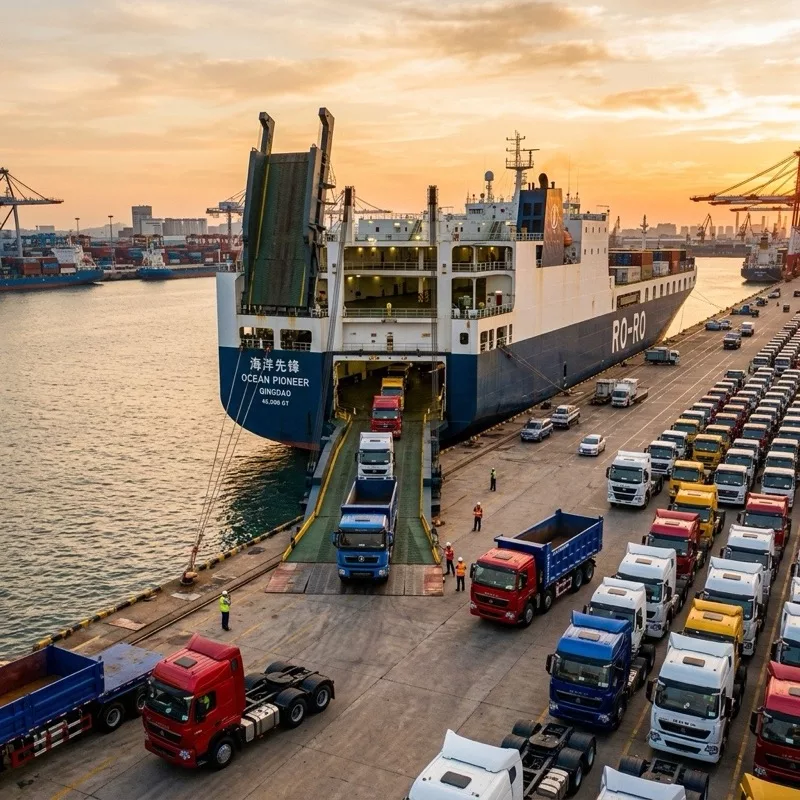
How We Ship Your Trucks — From Our Workshop to Your Doorstep
At Shandong TK, building the truck is only half the job. Getting it safely to your country — whether in Lagos, Dar es Salaam, Luanda, Lima or Buenos Aires — is equally critical. We have years of experience shipping heavy vehicles by sea to Africa and Latin America, working with trusted logistics partners and freight forwarders across major Chinese ports.
This guide covers everything: shipping methods, port selection, documentation, customs and what to expect when your truck arrives.
Shipping Methods — Which One Is Right for Your Truck?
1. RoRo (Roll-on, Roll-off) — The Most Popular for Trucks
How it works: Your truck is driven directly onto a specialised car carrier vessel. It rolls on at the Chinese port and rolls off at the destination port — no container, no crane lifting.
- Best for: Complete trucks (dump trucks, tractors, cargo trucks) that can be driven
- Advantages: Cheapest option for single vehicles. No dismantling required. Fast loading/unloading. Less risk of damage than lifting.
- Limitations: The truck must be driveable (engine running, wheels turning). Nothing can be loaded inside the truck cabin or on the cargo bed (customs restriction). Schedule depends on RoRo vessel availability — not all ports have weekly RoRo services.
- Typical cost (China → West Africa): $2,500–$5,000 USD per unit depending on truck size and destination.
- Transit time: 25–40 days to West Africa, 30–45 days to East Africa, 35–50 days to Latin America.
Our practice: Before RoRo loading, we prepare every truck at our workshop: full fluid check, battery disconnect, mirror fold, antenna removal, fuel tank at quarter level. We photograph the truck from 8 angles and provide you with a pre-shipment inspection report.
2. Flat Rack Container — For Oversized Vehicles
How it works: The truck is loaded onto an open-top flat rack container (20ft or 40ft) and secured with chains and lashing straps. The flat rack is then loaded onto a standard container vessel.
- Best for: Trucks with mounted equipment that exceeds container dimensions (crane trucks, concrete mixers, trucks with high superstructures). Also ideal for non-running vehicles (reconditioned trucks before final assembly).
- Advantages: Can ship oversized cargo. The truck doesn’t need to be driveable. More frequent vessel schedules than RoRo. Can ship partially assembled vehicles.
- Limitations: More expensive than RoRo. Requires crane loading at origin. Exposed to weather during transit (though trucks are built for outdoor conditions).
- Typical cost: $4,000–$8,000 USD depending on dimensions and route.
Our practice: We supervise flat rack loading at the port to ensure proper weight distribution, correct chain tension and adequate corner protection. Each lashing point is documented and photographed.
3. Container Shipping (20ft / 40ft) — For Parts and Light Vehicles
How it works: Cargo is loaded inside a standard 20ft or 40ft enclosed container. For trucks, this method is used when shipping disassembled vehicles or bulk spare parts.
- Best for: Spare parts shipments. CKD (Completely Knocked Down) or SKD (Semi Knocked Down) truck kits. Light vehicles that fit inside a container. Multiple small items consolidated.
- Advantages: Full weather protection. Best security (sealed container). Most frequent vessel schedules — weekly departures from most Chinese ports. Cheapest per cubic metre for consolidated cargo.
- Limitations: Complete assembled trucks generally don’t fit inside a standard container (height limitation ~2.6m internal).
- Typical cost: $1,500–$4,000 USD per container depending on size and route.
Our practice: For spare parts orders, we consolidate multiple items into a single container to reduce your per-unit shipping cost. Each item is labelled, inventoried and packed with appropriate protection (foam, wooden crates for fragile components).
4. Bulk Carrier — For Large Fleet Orders
How it works: When shipping 20+ trucks simultaneously, we can charter space on a bulk cargo vessel or arrange deck cargo on a general cargo ship.
- Best for: Fleet orders of 20–100+ vehicles. Government contracts. Mining company fleet purchases.
- Advantages: Significant per-unit cost savings. Direct port-to-port routing possible (avoiding transhipment). All vehicles arrive together.
- Limitations: Longer planning lead time (4–8 weeks). Minimum volume required. Limited port options.
Our practice: For fleet orders, we coordinate the entire logistics chain: production scheduling, pre-delivery inspection of all units, convoy transport to the port, bulk loading supervision and consolidated documentation.
Our Port Network in China
We ship from the ports best suited to your destination:
- Shanghai — China’s busiest port. Best connectivity to all global destinations. Our primary port for Latin American shipments.
- Qingdao — Closest major port to our Liangshan workshop (Shandong Province). Shortest inland transport. Excellent connections to Africa.
- Tianjin — Northern China’s main port. Strong RoRo services to West Africa and the Middle East.
- Guangzhou / Nansha — Southern China port. Best for Southeast Asian destinations and some African routes via the Indian Ocean.
- Lianyungang — Alternative port in Jiangsu Province. Competitive rates for certain African routes.
We select the departure port based on vessel schedules, freight rates and transit time to your destination. Our freight partners provide us with competitive rates across all major Chinese ports.
Shipping to Africa — What You Need to Know
West Africa (Nigeria, Ghana, Cameroon, Senegal, Côte d’Ivoire)
West Africa is our largest export market. Key ports include Lagos (Apapa/Tin Can Island), Tema, Douala, Dakar and Abidjan. RoRo services are well established to Lagos and Tema with departures every 2–3 weeks from Chinese ports. Customs procedures vary by country — Nigeria requires a SONCAP certificate (Standards Organisation of Nigeria) for vehicle imports. We prepare all required documentation including Form M, Certificate of Origin and Commercial Invoice.
East Africa (Tanzania, Kenya, Mozambique, Ethiopia)
Main ports: Dar es Salaam, Mombasa, Maputo, Djibouti (gateway to Ethiopia). Transit times are typically 30–40 days from China. For landlocked countries like Ethiopia, Uganda, Rwanda, Zambia and Zimbabwe, we arrange port clearing and inland transport coordination with our local partners. Ethiopia requires ESLSE (Ethiopian Shipping & Logistics Services Enterprise) involvement for all imports.
Southern Africa (South Africa, Angola, DRC)
Ports: Durban, Luanda, Matadi/Pointe-Noire. South Africa has strict NRCS (National Regulator for Compulsory Specifications) requirements for vehicle imports. Angola uses the BIVAC pre-shipment inspection system. DRC shipments typically transit through Pointe-Noire (Congo-Brazzaville) or Dar es Salaam. We handle the specific documentation requirements for each country.
North Africa (Egypt, Algeria, Libya)
Ports: Alexandria, Algiers, Misrata. Shorter transit times (20–25 days). Algeria requires import licenses for vehicles. Egypt has specific customs duties based on engine capacity. We provide CIF quotations including all duties estimates for North African destinations.
Shipping to Latin America — Growing Market
South America (Brazil, Peru, Chile, Colombia, Argentina)
Key ports: Santos (Brazil), Callao (Peru), Valparaíso (Chile), Buenaventura (Colombia), Buenos Aires (Argentina). Transit times from Shanghai are 35–50 days. Brazil requires INMETRO certification for vehicle imports. Peru and Chile have more open import policies for used and new commercial vehicles. We provide all documentation in Spanish or Portuguese as required.
Central America & Caribbean (Mexico, Panama, Dominican Republic)
Ports: Manzanillo (Mexico), Colón (Panama), Santo Domingo. Panama is often used as a transhipment hub for the region. Mexico has NOM certification requirements. Transit times are 30–40 days via the Pacific route.
Important for Latin America: Some countries have age restrictions on imported vehicles (e.g., no vehicles older than 5 years). Our new factory-direct trucks comply with all age requirements. For reconditioned vehicles, we verify the destination country’s import regulations before starting the rebuild.
Documentation We Provide
For every shipment, Shandong TK provides a complete documentation package:
- Commercial Invoice — Detailed description, quantity, value (FOB or CIF)
- Packing List — Dimensions, weights, VIN numbers
- Bill of Lading (B/L) — Original shipping document (3 originals + copies)
- Certificate of Origin — Issued by the Chinese Chamber of Commerce (CCPIT)
- Vehicle Registration Certificate — Chinese deregistration document for used vehicles
- Pre-Shipment Inspection Certificate — When required by destination country (BIVAC, SGS, Bureau Veritas, Cotecna)
- SONCAP/COC — For Nigeria-bound shipments
- Customs Declaration — Chinese export customs clearance documents
- Insurance Certificate — Marine cargo insurance (if CIF terms)
- Photos & Video — Pre-shipment condition report with timestamped images
Incoterms — Understanding FOB, CIF and DDP
FOB (Free on Board) — Most Common
We deliver the truck to the Chinese port, load it onto the vessel and clear Chinese customs. You arrange and pay for sea freight and insurance. This gives you control over shipping costs and lets you use your own freight forwarder.
CIF (Cost, Insurance, Freight)
We handle everything up to the destination port: truck delivery, Chinese customs, sea freight and marine insurance. You handle port clearance and customs duties at destination. This is the easiest option for buyers who don’t have a freight forwarder.
DDP (Delivered Duty Paid) — Full Service
We handle the entire chain: production, Chinese customs, sea freight, destination port clearance, customs duties and inland delivery. The truck arrives at your location ready to work. Available for select destinations where we have established customs broker partnerships.
Our Shipping Commitments
- Pre-shipment inspection — Every vehicle photographed and documented before loading
- Real-time tracking — We provide vessel name, voyage number and tracking links
- Insurance — Marine cargo insurance available on all shipments
- Documentation accuracy — We know the specific requirements for each destination country and prepare documents accordingly
- Communication — Dedicated logistics coordinator for each shipment, available via WhatsApp, email or phone
Ready to Ship?
Whether you’re buying a single dump truck for a construction project in Lagos or a fleet of 50 tractors for a mining operation in Peru, we handle the logistics with the same level of care and professionalism.
Contact our logistics team at [email protected] / [email protected] or call +86 190 2209 2829 or +86 152 6371 7102 (WhatsApp available). Tell us your destination and we’ll provide a complete quotation including truck price, shipping cost and estimated delivery date.
Leave a Reply